
The 2024 editions of ISO 55000 and ISO 55001, released by ISO/TC 251, fully replace the previous versions and mark a significant step forward in the practical, digital, and compliance-driven implementation of asset management systems. The updated standards place greater emphasis on core elements such as decision-making frameworks, lifecycle management, leadership accountability, and workforce competency. To further strengthen the asset management framework, ISO has also introduced two supporting standards: ISO 55012, which focuses on people engagement, and ISO 55013, which provides guidance on data management. Together, these standards create a more comprehensive and integrated system for modern asset management. Meanwhile, the revision of ISO 55002 has entered the voting stage and is expected to be published in 2027. The updated guidance is anticipated to provide additional practical direction in key areas including digital transformation, artificial intelligence applications, and climate change considerations.
I. Core Enhancements in the New ISO 55001:
Seven Key Changes
Clearer Asset Management Decision-Making and SAMP Alignment: The updated standard introduces a dedicated Decision-Making Framework (DMF), providing a clearer and more structured pathway for translating organizational objectives into asset management strategies and actions through the Strategic Asset Management Plan (SAMP).
Stronger Full Lifecycle Management Requirements: Operational planning and control requirements have been strengthened to cover the entire asset lifecycle from needs identification, acquisition, operation, and maintenance to modification and decommissioning. This promotes a shift from reactive maintenance to proactive lifecycle management focused on maximizing asset value.
Expanded Focus on Leadership and Workforce Competence: Leadership responsibilities are broadened to emphasize that effective asset management is a shared responsibility across all organizational levels. Supported by ISO 55012, the standard establishes a framework for employee engagement, competency development, and organizational capability building to ensure successful implementation.
Structured Management of Risks and Opportunities: Risks (potential negative events) and opportunities (conditions that enable performance improvement) are clearly distinguished and managed separately. This approach provides a strong foundation for risk-based decision-making and aligns well with GMP risk management practices in the pharmaceutical industry.
Predictive Action Replaces Preventive Action: The standard shifts its focus from traditional preventive measures to predictive action, leveraging data, risk indicators, and trend analysis to enable early warning, proactive intervention, and dynamic control.
Data, Information, and Knowledge Become Core System Elements: For the first time, dedicated requirements for data, information, and knowledge management are incorporated into the standard. Together with ISO 55013, these requirements support a strategic and governance-based approach to managing asset data throughout its lifecycle.
Asset Value Defined by Function and Business Contribution: The standard moves beyond the traditional view that fully depreciated assets have little or no value. Instead, asset value is evaluated based on functional performance, risk profile, maintenance effectiveness, and contribution to business objectives, ensuring closer alignment with organizational strategy.
II. From ISO 55000/55001 to GMP:
Shared Objectives and Pharmaceutical-Specific Requirements
Equipment asset management in the pharmaceutical industry must satisfy both the ISO 55000 asset management framework and GMP regulatory requirements. While the two share many common principles, GMP also introduces industry-specific expectations.
1. Areas of Strong Alignment:
Lifecycle Management:
ISO 55001 promotes end-to-end management of assets throughout their lifecycle, from requirements definition to retirement.
Similarly, GMP requires facilities, utilities, and equipment to remain in a validated state throughout their lifecycle from design and installation through operation, maintenance, and decommissioning. Both frameworks emphasize process control and continuous improvement.
Risk-Based Management:
ISO 55001 treats risks and opportunities as the foundation for decision-making.
Likewise, GMP is inherently risk-based, requiring risk assessments for equipment impact, calibration, maintenance, and other critical activities.
Data Integrity and Traceability:
ISO 55013 provides guidance on managing asset-related data and information.
GMP requires computerized systems to ensure data integrity through controls such as audit trails, user access management, and secure record retention.
Change Management and Predictive Action:
ISO 55001 emphasizes predictive actions.
GMP requires formal change control processes and ongoing efforts to maintain the validated state.
2. Compliance:
Regulatory Compliance:
GMP is a mandatory regulatory requirement, and noncompliance can result in production shutdowns.
By contrast, ISO 55001 is a voluntary management system standard.
Maintaining the Validated State:
GMP requires equipment to demonstrate continued validation following use, maintenance, repairs, or changes—not simply record operational activities.
Audit Trails and Electronic Signatures:
For computerized systems, GMP requires compliance with 21 CFR Part 11 requirements for audit trails, electronic records, and electronic signatures.
Direct Impact on Product Quality:
Equipment failures can lead to contamination, cross-contamination, incorrect dosing, or other quality defects, creating direct risks to product quality and patient safety.
Data Integrity Throughout the Lifecycle:
GMP requires data to remain accurate, complete, consistent, and traceable throughout its entire lifecycle from creation and recording to processing, backup, retention, and archiving. Data falsification, unauthorized modification, or selective recording is strictly prohibited. As a result, audit trail functionality is a key focus during regulatory inspections.
For pharmaceutical manufacturers, an asset management system cannot simply adopt the general ISO 55001 framework. It must also incorporate GMP compliance requirements into its design and operation. This principle serves as the foundation of Morimatsu's Equipment Lifecycle Management System (Mo-EAMaster).
III. Morimatsu Mo-EAMaster:
A Pharmaceutical-Specific Asset Management System Designed to Meet Both ISO 55001 and GMP Requirements
Morimatsu Mo-EAMaster is an enterprise asset management (EAM) platform developed specifically for the pharmaceutical industry. Built on the ISO 55000 series standards and GMP requirements, it incorporates more than 30 years of Morimatsu's experience in equipment manufacturing, process systems, and plant engineering. The platform enables digital management of equipment across its entire lifecycle—from procurement, design, and construction through installation, operation, maintenance, and retirement.
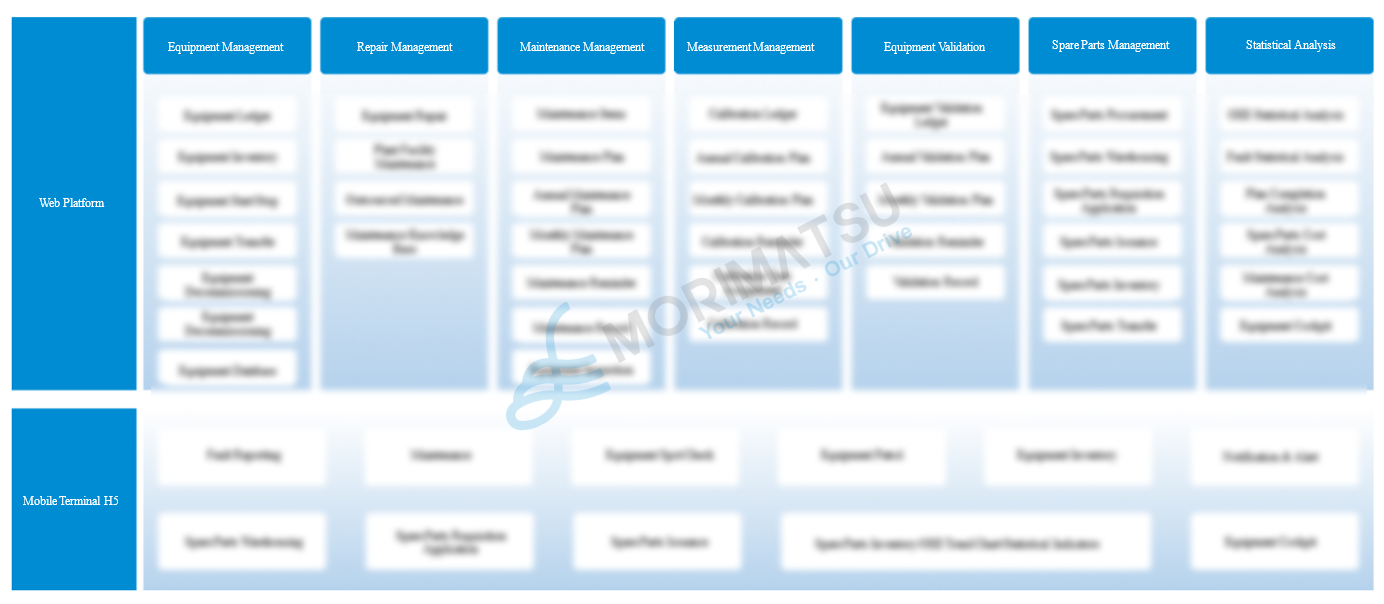
GMP-Compliant by Design: Aligned with GAMP 5 and FDA 21 CFR Part 11 requirements, the system includes built-in electronic signatures, role-based access controls, and audit trail functionality to support regulatory compliance and inspection readiness.
Closed-Loop Full Lifecycle Management: The platform manages the complete equipment lifecycle, including URS, SIA assessments, commissioning and acceptance, operation and maintenance, calibration, revalidation, and decommissioning. A fully traceable data chain provides one-click access to historical equipment records and lifecycle documentation. (Supports ISO 55001 8.1)
8.1Operational planning and control including life cycle management
The organization shall plan, implement and control the processes including life cycle processes, needed to meet requirements, and to implement the actions determined in Clause 6, the asset management plan(s) determined in 6.2, and actions determined in Clause 10 by:
a) establishing criteria for the required processes;
b) implementing the control of the processes, in accordance with the criteria;
NOTE1 Life cycle processes can include the creation, acquisition, utilization, maintenance, improvement. renewal, and disposal of assets.
Acquisition can be either purchase, lease or design, build, installation or commissioning or other asset.
NOTE2Acquisition can be either purchase, lease or design, build, installation or commissioning or other asset based capability provisioning, such as public-private-partnership or build-own-operate.
NOTE3 Disposal includes extinguishment of liability from owning, managing or operating the asset.
NOTE4 Improvement can include re-purpose of assets as well as modification.
NOTE5 Life cycle activities can include or be based on predictions of the asset state in any life cycle stage.
c) monitoring and treating risks using the approach specified in 6.1.2;
d) monitoring and implementing opportunities using the approach specified in 6.1.3;
e) ensuring that the opportunities, risks, costs, and performance are managed to realize value across the asset life cycle within the organization's period of responsibility.
NOTE6 Where an organization's period of responsibility is shorter than the asset life cycle (or in case of service providers, the client's period of responsibility), it can be necessary to take the required state of the asset into account.
Documented information shall be available to the extent necessary to have confidence that the processes have been carried out as planned.
Reference: BS ISO 55001:2024 (Asset management - Asset management system - Requirements).
Multi-Platform Collaboration with Offline Capability: The system supports PC, mobile, and web-based (H5) access. Offline data caching on mobile devices enables inspections and data collection in cleanroom environments without network connectivity, with automatic synchronization once a connection is restored.
Automated Revalidation and AI-Driven Predictive Maintenance: Mo-EAMaster automatically generates revalidation schedules and status notifications. AI-powered analytics help organizations move beyond traditional time-based maintenance by enabling risk-based preventive maintenance and data-driven predictive maintenance based on historical performance trends. (Supports ISO 55001 10.3, Predictive Actions.)
10.3 Predictive Action
The organization shall establish processes to predict the need for decisions relating to assets, asset management and the asset management system. In establishing these processes, the organization shall consider the need to:
a) determine the occurrences and impacts of both non-conformities in, and opportunities for improvement of assets, asset management and the asset management system;
b) determine the optimal intervention points, e.g. for maintenance, renewal, replacement and disposal of assets;
c) identify the inputs needed to:
-determine the relationship of asset condition to performance, opportunity, risk and cost;
-determine asset depreciation and financial value.
When a potential nonconformity or opportunity is determined, the organization shall apply the requirements in 10.2 and integrate these actions in its asset management planning.
The organization shall report to relevant stakeholders on the long-term effect from decisions made based onpredictive actions on assets and asset management performance.
The updated ISO 55000/55001 standards provide a clearer and more digitally focused framework for asset management. For pharmaceutical manufacturers, the key challenge is integrating ISO's strategic asset management principles with GMP's mandatory compliance requirements.
Designed specifically for pharmaceutical operations, Morimatsu's Mo-EAMaster bridges the gap between standards and regulations, strategy and execution, and equipment and data. By connecting the entire equipment lifecycle within a single digital platform, it helps organizations strengthen equipment management, simplify compliance and audit readiness, and maximize asset value throughout the lifecycle. As a result, Mo-EAMaster provides a practical and effective solution for modern asset management in the pharmaceutical industry.
About Morimatsu LifeSciences
Morimatsu LifeSciences is a key business segment of Morimatsu International Holdings Limited (Stock Code: 2155.HK). It comprises Shanghai Morimatsu Pharmaceutical Equipment Engineering Co., Ltd., Morimatsu (Suzhou) LifeSciences Co., Ltd., Shanghai Morimatsu Biotechnology Co., Ltd., Shanghai Mori-Biounion Technology Co., Ltd., Shanghai Morisora Technology Co., Ltd., Bioengineering AG, Pharmadule Morimatsu AB, and its affiliated companies.
Morimatsu LifeSciences is dedicated in providing core equipment, process systems, and smart modular facility solutions, and services for the pharmaceutical, biopharmaceutical, medical aesthetics, and fast-moving consumer goods (FMCG) sectors including (cosmetics, food, and health supplements), as well as data centers.
Our team comprises highly experienced professionals with deep expertise in process R&D, engineering design, advanced manufacturing, compliance and validation consulting, production execution, and intelligent operations. With broad experience across diverse industries, we fully understand the unique characteristics and process requirements of various products. This enables us to deliver tailored, end-to-end process solutions from the conceptual design stage, precisely aligned with client’s specific needs.
Morimatsu LifeSciences has established a strong global presence, supported by advanced R&D centers, design hubs, and state-of-the-art manufacturing facilities worldwide. Our well-established service network spans Europe,USA,Asia-Pacific, and emerging markets. We have successfully delivered outstanding, customized solutions to clients in over 40 countries and regions, gaining extensive experience in international project execution.
As a multinational enterprise with core strengths in process technology, modular facility construction, and intelligent manufacturing, Morimatsu LifeSciences is dedicated to meeting the evolving equipment and system needs of our key industries. Through continuous innovation and technological advancement, we are steadily expanding our global footprint, driving our international strategy forward, and delivering Morimatsu’s expertise, reliability, and innovation to the global life sciences and related sectors.